After the WARN Notice: What Happens to a Plant's Spare Parts When It Closes
ROCHESTER, N.Y. — Rochester and Western New York have spent decades navigating the changing landscape of American manufacturing. Once home to some of the nation's most prominent industrial operations, the region has seen factories close, production lines relocate and manufacturing facilities consolidate as companies respond to shifting markets, global competition and changing business models.
The trend extends well beyond Western New York. Across the Northeast and Great Lakes, from Pennsylvania and Ohio to Michigan and New England, manufacturing communities have faced similar challenges over the past 20 years. As industrial operations move, consolidate or disappear altogether, the impact reaches beyond the companies and workers directly affected, raising questions about the future of the facilities and infrastructure left behind.
When a manufacturing plant closes, the public conversation follows the people first, and it should. A WARN notice is filed, the job count makes the news and workforce agencies step in to help. But once the headlines fade and workers move on.
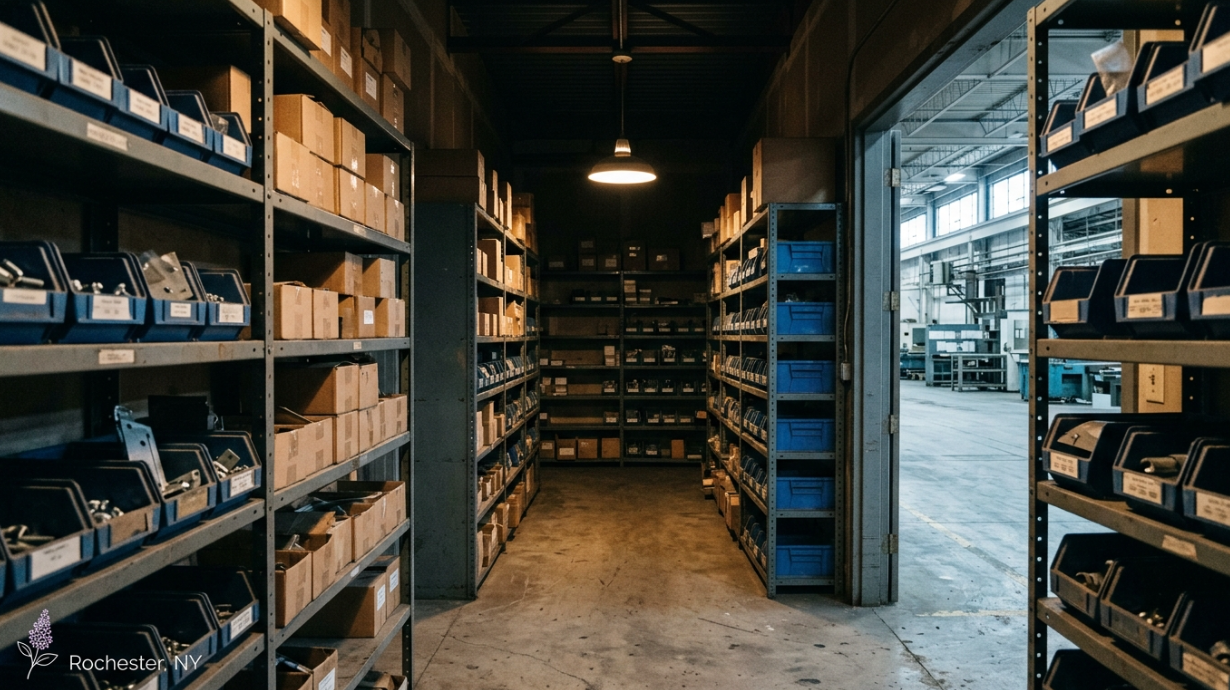
What rarely makes the story is what stays behind. Most plants keep a storeroom of maintenance, repair and operations (MRO) spare parts: bearings, motors, drives, controllers, circuit boards, industrial automation, electromechanical, valves and sensors bought to keep the lines running. When the lines stop, those shelves are usually still full.
That inventory is seldom the largest number in a closure plan. It is, however, one of the easiest to lose and one of the most useful to keep in circulation, especially regionally.
Closures Happen in Good Markets, Too
Manufacturing across New York and the broader Northeast continues to evolve, with investment, expansion and consolidation reshaping the industrial landscape. Despite decades of plant closures and production relocations, the sector continues to demonstrate resilience. In October, the Federal Reserve Bank of New York's Empire State Manufacturing Survey reported that its general business conditions index rose 18 points to 25.5, its highest level in nearly five years.
Growth, however, does not mean every facility remains in operation. As manufacturers modernize, pursue acquisitions and streamline operations, production is frequently consolidated into fewer locations. PwC's 2026 midyear industrial manufacturing deals outlook reported a record $173 billion in deal value over the previous year, a 28% increase from fiscal 2025. That activity reflects an industry undergoing significant transformation, where expansion and facility closures can occur simultaneously.
Rochester and the Finger Lakes have experienced this transition firsthand. In 2025, Upstate Niagara Cooperative announced plans to close its Rochester dairy processing plant and transfer production to other facilities. In nearby Bloomfield, Ontario County, polyester film manufacturer Terphane announced the closure of its plant, a facility originally developed by Eastman Kodak in the 1980s, following the company's acquisition in late 2024.
Neither case is unusual. Production moves, capacity gets rebalanced and buildings find new purposes. The storeroom full of industrial parts is usually one of the last items on the checklist.
Why Spare Parts Are a Separate Problem
Production equipment usually has a plan. It gets appraised, transferred to a sister plant or sold at auction, and lenders and acquirers pay close attention to it.\
Spare parts are different. A single storeroom can hold thousands of line items or SKUs, many still in the original box, bought over decades for machines that may already be gone. They are small, spread across bins, cabinets and shelving, and often poorly documented in the plant's maintenance system.
The people who know those parts best, the maintenance planners and storeroom staff, are often among those leaving. When they go, so does the knowledge of what each part fits and why it was stocked.
Where the Shelves Usually End Up
In practice, a closing plant's spare parts tend to follow one of a handful of paths:
- Transfer to a sister site or branch. Useful when another facility runs the same equipment, though it rarely covers the whole storeroom.
- Return to the manufacturer. Possible for some parts under a year old, usually at a meaningful discount and with limits on what will be accepted.
- Auction or scrap. Fast, but priced by the pallet or by the pound rather than by what the parts can do.
- Sale to a surplus buyer. Pays for the value of the parts. A buyer resells individual parts to other plants and maintenance teams, which keeps them in service.
- Holding the inventory. Often the default by inaction, carrying storage, insurance, tax and administrative costs while the parts age.
Each option has its place. The larger issue is timing: the decision is often made late, under deadline pressure, by people with the least context about what is on the shelves.
The Case for Keeping Parts in Circulation
A new bearing or drive sitting in a closed building is worth nothing to anyone. The same part on a shelf where a maintenance team can find it may keep another plant running.
That matters because factories routinely run equipment long after its manufacturer has moved on to a newer product line. Once a controller or circuit board is discontinued, much of the remaining supply is the inventory already sitting in storerooms. Scrapping it removes parts from a market where maintenance teams are actively looking for them.
There is an environmental case as well. Reuse is the most direct form of the circular economy: the part is already made, packaged and ready to install, and keeping it in service avoids both the waste in the landfill and the energy needed to make a replacement.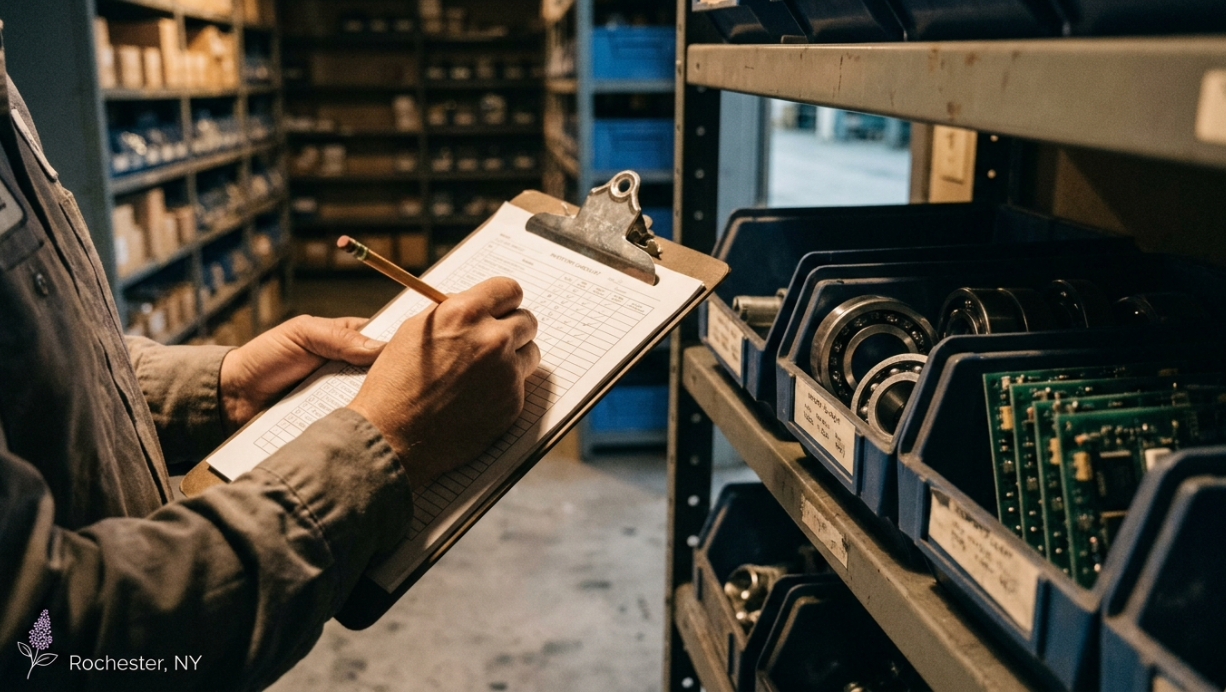
Questions to Ask Before the Last Shift
For leaders managing a closure, a consolidation or a post-acquisition integration, a few questions are worth asking early:
- Do we have a current list of the storeroom, with manufacturer, part number and quantity?
- Which parts can a sister site or the acquiring company actually use?
- Who owns the decision, and is it on the closure timeline rather than after it?
- What would another year of holding the inventory cost in space, insurance and taxes?
- Can the parts stay in use instead of being sold by weight?
The most important step is starting while experienced staff are still on site. A spreadsheet, or even a set of shelf photos taken before the last shift, preserves information that is very hard to rebuild later.
Why It Matters for Rochester
Rochester's industrial base was built by large manufacturers whose footprints have changed dramatically over the past four decades. That history left the region with deep maintenance and manufacturing know-how, along with long experience of facilities changing hands, consolidating and being repurposed.
The practical lesson for the region's manufacturers is that a closure plan is also an inventory plan. Industrial and MRO spare parts kept in service can support the plants expanding here, the maintenance teams keeping older lines running and the small businesses that serve both. Parts that end up in a scrap bin do none of those things.
With state manufacturing activity picking up and deal activity running at record levels, more facilities will consolidate in the years ahead. Treating the storeroom as a resource rather than a cleanup task is a small decision that keeps value, and useful equipment, working in the region.
This article was written by Brandon Kelley, President - Central Surplus. Founded in 2011, Central Surplus is a Rochester-based company that buys surplus industrial MRO inventory from manufacturing plants, power-generation plants and other industrial end users, in lots from a few boxes to 10 truckloads, and resells it nationwide from its Rochester warehouse, including more than 100,000 industrial products.